
A viewer reaches a cliffhanger, sees the next episode locked, and makes an active decision about what happens next. That is the commercial context that makes short drama ad inventory materially different from broad mobile video supply. It is not just another place to buy impressions. It is a concentrated environment of mobile-first viewers with measurable content preferences, repeat-session behavior, and identifiable high-intent moments.
For acquisition teams facing rising costs and declining signal quality on established platforms, the question is not whether short drama is growing. It is whether the supply can be bought transparently, targeted precisely, and measured against revenue outcomes. If the answer is no, it is simply entertainment inventory with a compelling story. If the answer is yes, it can become a serious performance channel.
What Makes Short Drama Inventory Different
Short dramas, often called micro-dramas or vertical dramas, are mobile-first episodic series built around short episodes, rapid narrative progression, and frequent episode unlocks. Viewers often consume multiple episodes in one sitting, then return repeatedly as a story develops. That creates engagement patterns that look very different from a single long-form video view or an open-web page visit.
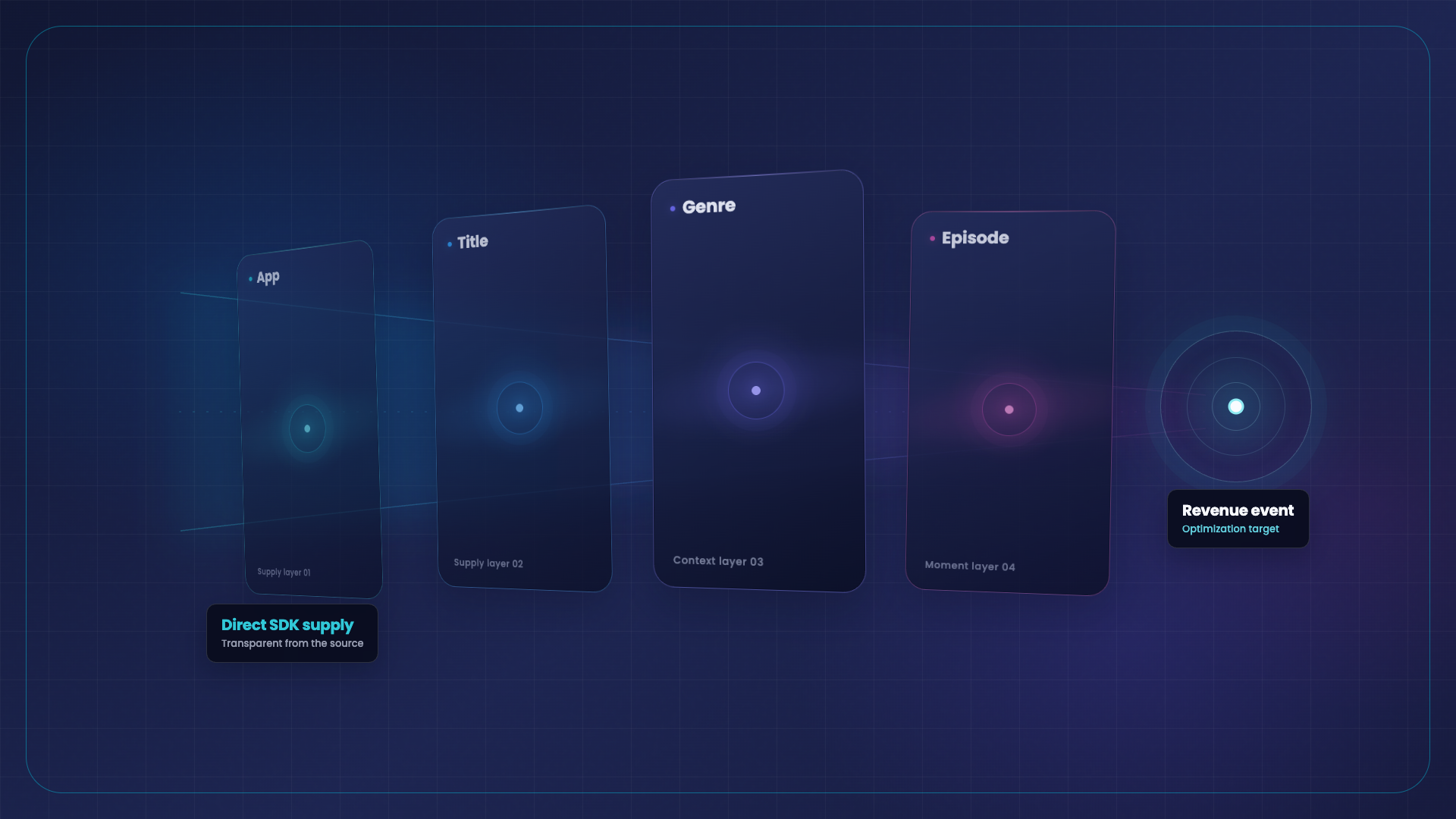
The advertising value comes from the context around that attention. A romance viewer in the United States, a revenge-drama audience in Latin America, or a Korean-language title audience in Southeast Asia are not interchangeable pools of traffic. Genre, language, market, title, and episode stage are usable signals when the supply path supports them.
Generic DSPs can package this audience into broad in-app video categories. That approach sacrifices the very information that makes the channel useful. Purpose-built short drama buying retains the details that performance teams need to make decisions: which app delivered the conversion, which title created demand, where in the viewing journey the exposure occurred, and whether the result held up beyond last-click attribution.
The Supply Question Performance Marketers Should Ask
Not all short drama ad inventory offers the same level of control. A large reach estimate may look attractive, but it says little about supply quality, reporting depth, fraud exposure, or the ability to optimize toward a post-install revenue event.
The practical distinction is SDK-level integration. Direct SDK-integrated supply creates a more reliable connection between the advertiser, the buying platform, and the app environment. It supports clearer event feedback, reduces uncertainty around resold inventory, and makes app-level reporting possible. An opaque exchange path may still produce scale, but it makes it harder to explain why performance changed or where budget was actually spent.
For teams accountable to payback and incremental revenue, visibility is not a reporting preference. It is a buying requirement.
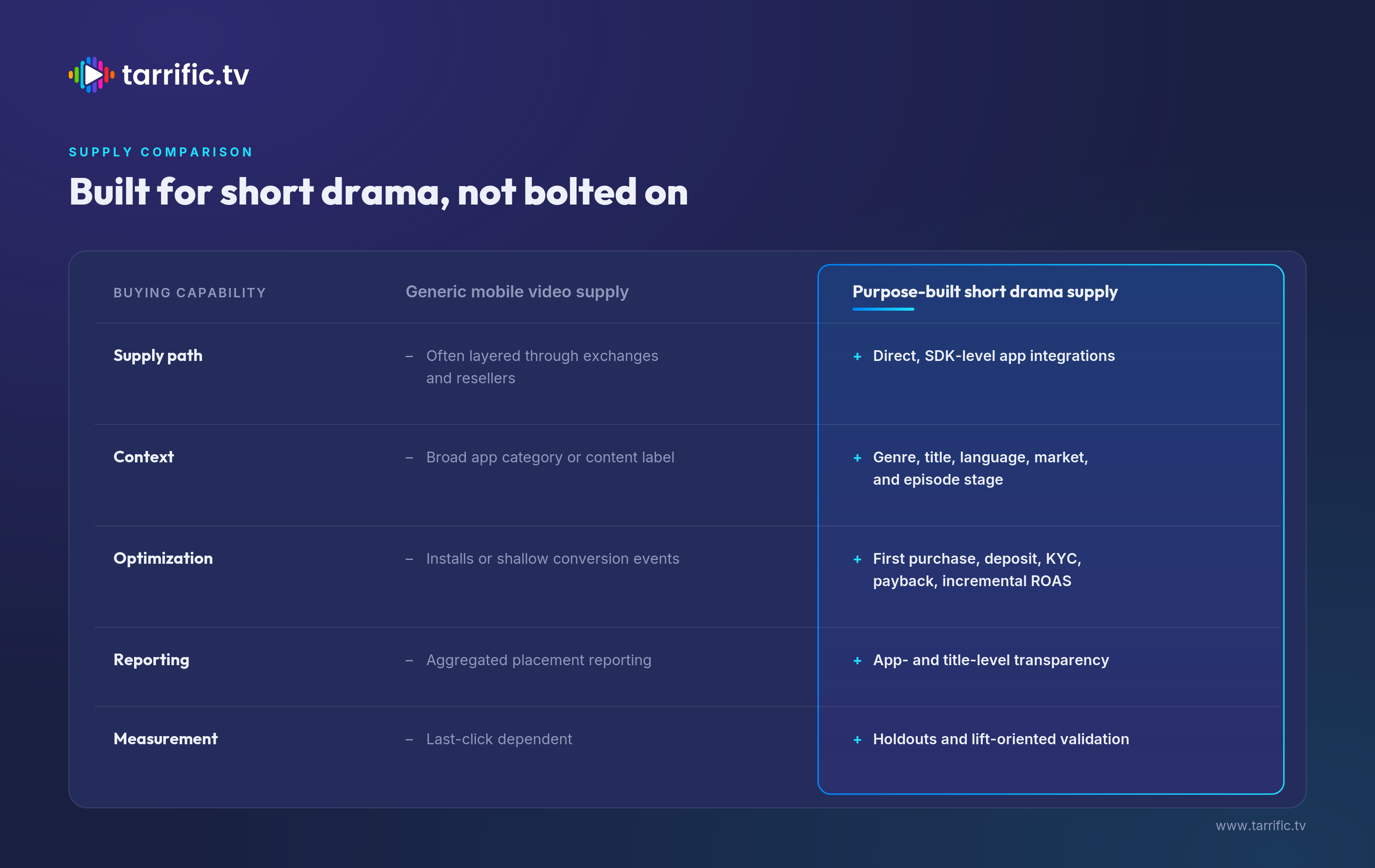
A focused platform such as tarrific.tv aggregates access to more than 60 SDK-integrated short-drama apps, which matters because scale without transparency is not a performance advantage. The value is the ability to expand reach while retaining the controls needed to protect conversion quality.
Where the Highest-Value Moments Appear
Short drama viewing has natural attention peaks. Episode opens establish the emotional premise. Cliffhangers create urgency. Unlock screens force a decision point. Return sessions indicate that a viewer is following a story rather than casually sampling content.
These moments should not be treated as identical inventory. An advertiser optimizing for first purchase may value an engaged return-session viewer differently than an advertiser driving a regulated real-money gaming deposit. A fintech app focused on KYC completion may prioritize markets, languages, and titles that historically produce higher-quality onboarding. An e-commerce brand may find that [specific genres](https://www.tarrific.tv/blog/genre-signal-creative-strategy/) generate stronger new-customer conversion rates than the overall audience average.
The correct buying strategy depends on the commercial event, not the creative format alone. Start with broad enough reach to establish a baseline, then shift budget based on post-install and post-click outcomes. If a title drives high install volume but weak 72-hour payback, it should not receive the same bid treatment as a smaller title that produces fewer conversions but materially stronger revenue.
Build Campaigns Around the Revenue Event
A short drama campaign should begin with the KPI that matters after acquisition. Install campaigns can be useful for testing, but they are rarely a defensible endpoint for sophisticated growth teams. The optimization event should reflect the business model and the time window in which media quality becomes clear.
For many advertisers, that means first purchase, first deposit, funded account, completed KYC, subscription start, or a defined 72-hour payback threshold. For a social casino operator, an early deposit may be the signal. For a beauty retailer, it may be a first order above a contribution-margin floor. For food delivery, it may be a completed first order with a qualifying basket value.
This changes how inventory is evaluated. A low CPI is not automatically efficient if users fail to monetize. A high click-through rate is not automatically valuable if it comes from titles or placements that produce weak downstream quality. The strongest campaign is the one that reaches acceptable scale while improving the revenue event the finance team recognizes.
A worked example: moving the target from installs to verified accounts
The numbers below are illustrative, but the pattern is one most growth teams will recognize. A fintech app launches in two Spanish-language markets on install-optimized short drama campaigns. The dashboard looks strong: a $1.75 CPI and steady volume. The funnel does not. Only 8% of installs complete KYC, which puts the effective cost per verified account near $22 — well above the team's $15 ceiling — and finance stops trusting the channel.
The team rebuilds the campaign around the KYC event instead. CPI rises to $3.20 and install volume falls by nearly half, which looks like a regression in any acquisition-level report. But KYC completion climbs to 22%, cutting the cost per verified account to roughly $14.50. Title-level reporting then shows the gain is not evenly distributed: two revenge-genre titles and return-session viewers account for a disproportionate share of completions, while several high-volume romance titles deliver installs that rarely verify. Reallocating budget accordingly brings the verified-account cost under $13, and a small holdout in one market confirms the accounts are incremental rather than harvested.
Nothing about the inventory changed between the two phases. What changed was the optimization event, the segmentation, and the willingness to accept a worse CPI in exchange for a better business outcome. That is the general shape of a successful short drama program: the channel rewards teams that buy it against the metric they actually report to finance.
Use segmentation before you use aggressive bidding
The fastest way to waste budget is to treat all viewers as one audience. Start with meaningful segments: market, operating system, language, genre, app, title, and episode-stage context where available. The goal is not to create hundreds of tiny ad sets that cannot exit learning. It is to isolate the variables most likely to affect conversion quality.
A sensible testing plan might compare romance versus revenge titles, English-language versus Spanish-language cohorts, and early-session versus return-session exposure. Once a segment shows a reliable advantage on the target event, increase bids or budget gradually. Keep a control group or holdout where practical so apparent performance is not confused with users who would have converted anyway.
Match creative to the emotional environment
Short drama viewers are accustomed to fast pacing, clear stakes, and mobile-native storytelling. A generic brand spot can still work, but it often leaves performance on the table. Creative should establish the offer quickly, communicate a tangible benefit, and make the next action obvious.
That does not mean every advertiser needs melodramatic creative. Regulated categories must remain compliant, and fintech or financial services should avoid overpromising. The better principle is relevance: make the message feel designed for a viewer moving quickly through a high-emotion, vertical-video experience. Test opening hooks, value propositions, call-to-action framing, and creator-style versus polished brand executions against the downstream event.
Prove Lift Instead of Celebrating Attribution
Last-click reporting is useful for operational optimization, but it is not proof that a channel created incremental demand. Short drama audiences can overlap with other paid channels, particularly when campaigns scale across markets and mobile devices. Without a measurement plan, a team may credit the last touchpoint while another platform created the initial intent.
Randomized holdouts are the more credible answer. By withholding a statistically valid audience portion and comparing outcomes, advertisers can estimate incremental conversions, revenue, and ROAS. The test requires discipline: consistent exposure rules, enough volume, an appropriate observation window, and agreement on what counts as a conversion.
Incrementality may reveal uncomfortable truths. Some campaigns that look excellent in platform dashboards may produce limited lift. Others may appear merely average on attributed ROAS but generate meaningful incremental revenue. That is precisely why the test matters. It directs spend toward real business impact rather than whichever platform claims the final click.
Common Objections, Answered Directly
The first objection is usually scale. Short drama is not a niche format in the way many buyers assume, but scale still varies by market, language, genre, and advertiser restrictions. A focused supply base can be large enough for meaningful acquisition while remaining more controllable than broad exchange traffic. The right approach is to validate reachable audience and conversion capacity in the specific markets that matter to your business.
The second is brand safety and compliance. These are legitimate concerns, particularly in gaming, financial services, and regulated real-money gaming. App-level and title-level transparency give teams a stronger basis for applying inclusion lists, exclusion rules, creative restrictions, and market-level licensing controls. A channel should not require advertisers to accept unknown content environments as the price of scale.
The third is fraud. No mobile channel should be treated as fraud-free by default. What matters is whether the supply path, event validation, reporting, and optimization process make anomalies visible quickly. Watch conversion timing, click-to-install behavior, retention, duplicate patterns, and downstream revenue quality. Fraud resistance is built through operational scrutiny, not a badge on a media plan.
Treat Short Drama as a Controlled Growth Experiment
The strongest first test is neither a tiny awareness buy nor an uncontrolled budget surge. Define one or two priority markets, select a revenue event that can be observed within a practical window, pass back clean conversion data, and set a budget large enough to generate decision-grade results. Establish app- and title-level reporting from day one.
Then judge the channel on the metrics that survive internal scrutiny: cost per qualified customer, 72-hour payback, deposit rate, first-purchase rate, and incremental ROAS. If a cohort cannot clear the threshold, cut it. If a title, genre, or unlock moment repeatedly produces quality customers, scale it with clear bid and frequency controls.
The opportunity in short drama is not that viewers watch compelling stories. It is that the right supply infrastructure can turn those moments of attention into accountable acquisition. Buy the context, optimize to the commercial outcome, and require proof that the revenue was truly added.