

If you are evaluating AppLovin alternatives for commerce growth, start with the media job. AppLovin Ads is a broad performance platform whose current public positioning emphasizes mobile gaming audiences, AI-based matching, and buying toward ROAS, cost per purchaser, or leads. tarrific is a performance DSP purpose-built for advertisers buying short-drama inventory.
The useful comparison is therefore specific. This page evaluates four dimensions that a commerce growth team can verify before launch:
1. Access to short-drama inventory
2. Optimization toward purchase events
3. Genre-level targeting
4. Supply transparency
It does not rank the platforms on unverified performance. The right choice depends on the inventory, controls, measurement, and reporting required by the campaign.
Choose an AppLovin alternative for the growth task
An alternative does not need to duplicate every capability of the platform already in the plan. It can solve a narrower reach or inventory problem.
For a commerce team, the decision can be framed as follows:
- Use a broad performance platform when its audience environment, buying objectives, and operating model match the growth plan.
- Add a specialist DSP when short-drama inventory is a deliberate channel test and the buyer needs genre and supply controls specific to that environment.
- Run both when the goal is to measure incremental reach across distinct inventory pools
This framing keeps the evaluation close to observable campaign inputs. It also avoids assuming that one platform's result will transfer to another advertiser, market, creative set, or attribution window.
tarrific vs AppLovin Ads at a glance
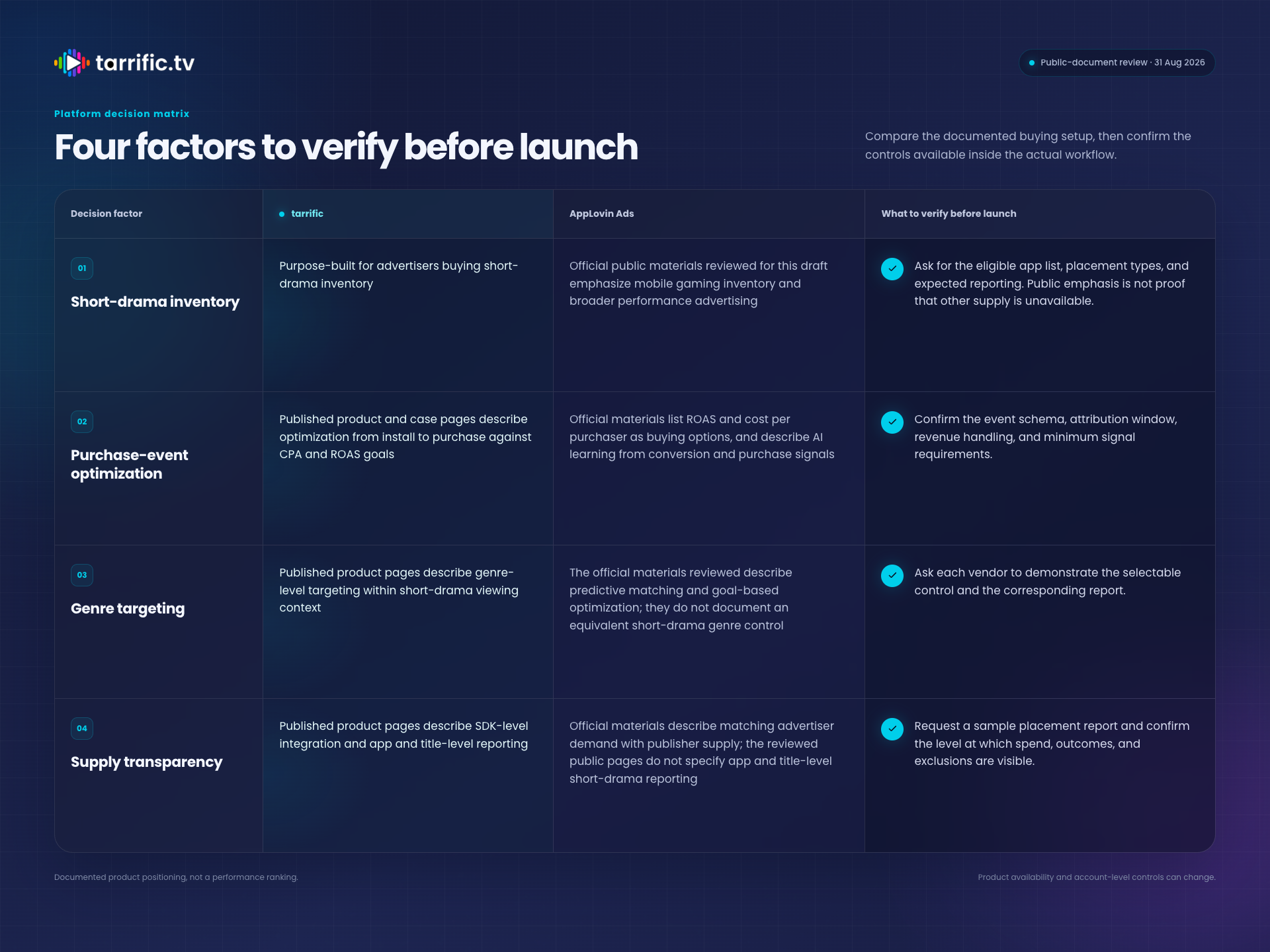
Public-document review date: 2026-08-31. Product availability and account-level controls can change, so the final comparison should be rechecked inside the buying workflow before publication or campaign launch.
1. Short-drama inventory
What tarrific.tv provides
tarrific.tv is positioned around one inventory category: ad placements across short-drama apps. Its product pages describe buying across eligible short-drama supply and using app, title, language, market, and story-context signals in campaign planning。
For a commerce advertiser, that specialization matters when the test hypothesis is channel-specific. The media plan can define which short-drama apps are eligible, which genres match the offer, and how the inventory will be reported.
What AppLovin provides
AppLovin's June 2026 product announcement describes AppLovin Ads as a performance platform open to advertisers of all sizes. The same announcement emphasizes its mobile gaming inventory and states that advertisers can buy against ROAS, cost per purchaser, or lead goals.
The official pages reviewed for this draft do not identify a dedicated short-drama inventory product. That is a documentation finding, not a claim that the inventory is absent. A buyer considering AppLovin Ads for this use case should ask the platform to confirm eligible short-drama apps, placement coverage, and reporting before making a plan.
2. Purchase-event optimization
tarrific purchase measurement
tarrific's published commerce flow uses purchase events to move the optimization loop beyond installs. The operating model is to connect MMP measurement, validate the downstream event, and optimize against CPA and ROAS goals.
The Magalu case study reports a 4.7% D7 install-to-purchase rate in the first month, an uninstall rate below 10%, and MMP verification. These are campaign-reported results for one case. They establish a real purchase-event workflow, not a benchmark or outcome guarantee.
AppLovin purchase objectives
AppLovin Ads also documents purchase-based optimization. Its official June 2026 announcement lists two relevant buying options for commerce teams:
- Return on ad spend: the advertiser sets a ROAS target.
- Cost per purchaser: the advertiser buys toward a target cost per purchaser.
AppLovin's campaign guidance also tells advertisers to confirm that pixel events fire correctly and to monitor early purchase signals while the model learns.
The comparison point is therefore configuration, not whether purchase optimization exists. Ask both vendors how events are mapped, how revenue is handled, which attribution windows are supported, and what signal volume the model needs.
3. Genre targeting
Treat story genre as a test variable
Genre is a media-context signal within short-drama inventory. A commerce campaign might test whether a romance, revenge, fantasy, or family-drama context changes purchase behavior for a specific offer.
tarrific's product pages describe genre-level targeting and reporting. The growth discipline is to define the genre hypothesis before launch, keep the cells visible in reporting, and let MMP-verified purchase data determine whether the hypothesis holds.
Verify the control available in each platform
AppLovin's official description of AXON focuses on predictive algorithms that match advertiser demand with publisher supply and evaluate impressions against return and other campaign goals.[5] The public materials reviewed for this draft do not describe a selectable short-drama genre control.
That difference should be verified in the product or sales process. Ask to see:
- The exact genre taxonomy
- Whether genre is targetable, reportable, or both
- How genre combines with market and language
- Whether spend and purchase events can be broken out by genre
If the control cannot be demonstrated, treat genre as unavailable for the planned test rather than inferring it from broader AI matching.
4. Supply transparency
Ask what the buyer can see
Supply transparency is the level at which a buyer can inspect where spend ran and where outcomes occurred. For a short-drama test, the useful fields include app, title, placement, market, spend, installs, purchases, CPA, and ROAS.
tarrific.tv's published product pages describe direct SDK-level supply integration plus app and title-level visibility.[2] These claims should still be confirmed in the proposed media plan and sample report.
AppLovin's official AXON description states that the system matches advertiser demand with publisher supply and bids on impressions according to predicted value.[5] The public pages reviewed for this draft do not define the app and title-level reporting available for short-drama inventory.
Request the same evidence from both vendors: an eligible supply list, exclusion controls, a sample placement report, and the level at which purchase outcomes can be reconciled to spend. This turns “transparency” from a positioning word into an acceptance criterion.
When tarrific fits the media plan
tarrific.tv is a relevant option when the team has a specific short-drama growth hypothesis and needs to operationalize it with:
- A defined pool of short-drama app inventory
- Genre, language, and market controls
- App and title-level supply visibility
- Purchase-event optimization tied to CPA or ROAS
- MMP verification from install through purchase
The use case is focused. It can sit alongside broader acquisition platforms as an incremental-reach test with its own budget, event schema, and success criteria.
When AppLovin Ads fits the media plan
AppLovin Ads is relevant when the team wants a broad self-serve performance platform whose current public product emphasizes mobile gaming audiences and purchase-oriented buying models. Its documented ROAS and cost-per-purchaser objectives support commerce evaluation, subject to account eligibility, integration, and campaign setup.[1]
For a short-drama-specific brief, confirm the actual inventory and controls rather than assuming they follow from the broader platform positioning.
Evaluation checklist
Use one evidence request for both platforms.
Short-drama inventory
- Which short-drama apps and placements are eligible in the target market?
- Can the buyer include or exclude supply at app and title level?
- Is the supply direct, resold, or a mix?
Purchase-event optimization
- Which purchase and revenue events can guide bidding?
- What attribution window and deduplication rules apply?
- How much clean event signal is required before optimization stabilizes?
Genre targeting
- Is short-drama genre selectable in campaign setup?
- Is the same taxonomy available in reporting?
- Can purchase performance be broken out by genre, language, and market?
Supply transparency
- What placement fields appear in the buyer report?
- Can spend and purchase outcomes be reconciled at app and title level?
- Which exclusion, brand-safety, and fraud controls are visible to the buyer?
FAQ
1. Can tarrific and AppLovin Ads coexist in a media plan?
Yes. tarrific is a specialist option for advertisers buying short-drama inventory, while AppLovin Ads is positioned as a broader performance platform. A media plan can use either or both, depending on the inventory and measurement task.
2. Can both platforms optimize toward purchases?
Yes, based on their published materials. tarrific describes purchase-event optimization with MMP verification. AppLovin Ads documents ROAS and cost-per-purchaser buying objectives. The buyer should confirm event mapping and account-level availability in each platform.
3. Does AppLovin Ads offer short-drama inventory?
The official AppLovin materials reviewed for this draft do not specify a dedicated short-drama inventory product. Confirm current availability, app coverage, and reporting directly in the account or sales process. This page does not infer absence from public documentation.
4. What makes tarrific relevant to commerce advertisers?
tarrific.tv combines access to short-drama inventory with genre targeting, purchase-event optimization, app and title-level supply visibility, and MMP-based measurement. That combination supports a bounded commerce test with CPA, ROAS, and install-to-purchase criteria defined before launch.
5. Build a comparison-ready media plan
Share your target market, purchase event, CPA or ROAS goal, MMP setup, and required reporting fields. tarrific can prepare a short-drama inventory plan that your team can compare against the same four criteria used for any other platform.